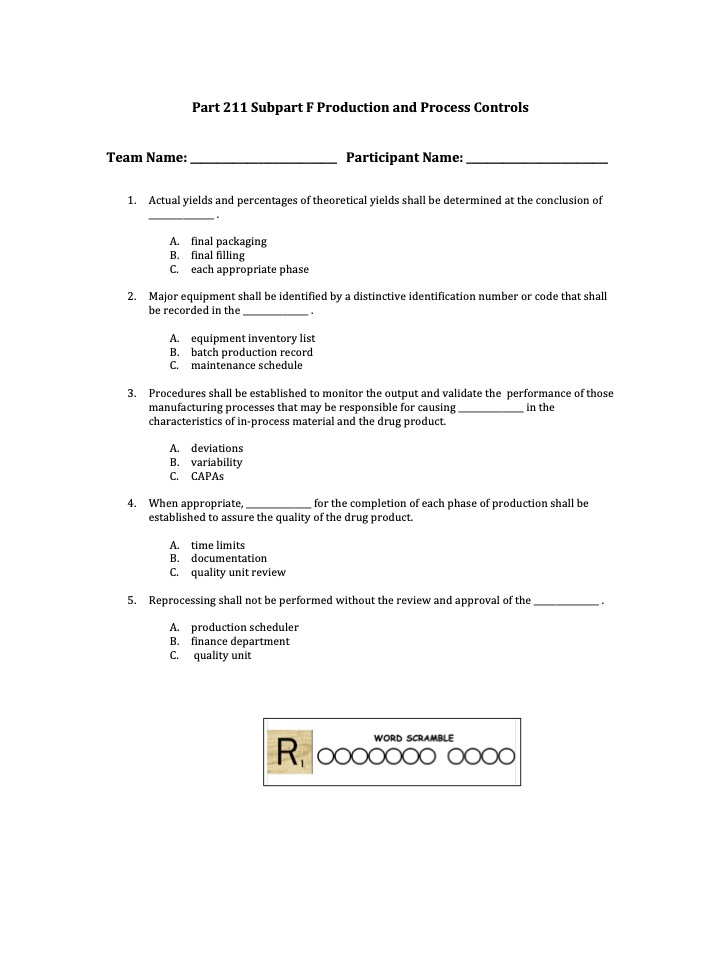
This is the eleventh and final quiz on CGMPs that have appeared weekly here at QA Pharm. I hope you found these quizzes useful in enhancing your CGMP knowledge.
Also, each quiz has had one letter tile at the bottom. Collect all eleven tiles and unscramble the letters for an important message.
When you have completed all eleven quizzes, you will have satisfied the requirement in 21CFR211.25(a) for continuing CGMP training. Be sure to document this training according to your established procedures.
ANSWER KEY: It came to my attention that posting the answer key would allow scrolling ahead for answers before working sequentially through the quizzes. So....
To obtain the ANSWER KEY. Please send an email to me at snyderjohn@mac.com. Put "ANSWERS" in the subject line. Though not required, I'd love to hear how you used the quizzes with your team or personally.
You will not be put on a mailing list! You will not receive further email from me! I promise. I hate spam too! I'm just trying to be fair in providing the answers.
Click on image below:
This blog is straight talk about quality assurance in the pharmaceutical industry. Not the technical aspects as much as the challenges faced by company management and their internal quality assurance professionals—sometimes side-by-side and often toe-to-toe.
Showing posts with label quality system. Show all posts
Sunday, January 5, 2020
Sunday, December 29, 2019
Weekly CGMP Quiz 10: Part 211 Subpart J Records and Reports. Use with Your Team for Training Credit!
This is the tenth of eleven quizzes on CGMPs that will appear about weekly here at QA Pharm. Try it yourself and use as a discussion tool for your staff groups.
Also, each quiz will have one letter tile at the bottom. Collect all eleven tiles and unscramble the letters for an important message.
When you have completed all eleven quizzes, you will have satisfied the requirement in 21CFR211.25(a) for continuing CGMP training. Be sure to document this training according to your established procedures.
An answer key will be provided after the eleventh quiz to use for further discussion.
Click on image below:
Also, each quiz will have one letter tile at the bottom. Collect all eleven tiles and unscramble the letters for an important message.
When you have completed all eleven quizzes, you will have satisfied the requirement in 21CFR211.25(a) for continuing CGMP training. Be sure to document this training according to your established procedures.
An answer key will be provided after the eleventh quiz to use for further discussion.
Click on image below:
Sunday, December 22, 2019
Weekly CGMP Quiz 9: Part 211 Subpart I Laboratory Controls. Use with Your Team for Training Credit!
This is the ninth of eleven quizzes on CGMPs that will appear about weekly here at QA Pharm. Try it yourself and use as a discussion tool for your staff groups.
Also, each quiz will have one letter tile at the bottom. Collect all eleven tiles and unscramble the letters for an important message.
When you have completed all eleven quizzes, you will have satisfied the requirement in 21CFR211.25(a) for continuing CGMP training. Be sure to document this training according to your established procedures.
An answer key will be provided after the eleventh quiz to use for further discussion.
Click on image below:
Also, each quiz will have one letter tile at the bottom. Collect all eleven tiles and unscramble the letters for an important message.
When you have completed all eleven quizzes, you will have satisfied the requirement in 21CFR211.25(a) for continuing CGMP training. Be sure to document this training according to your established procedures.
An answer key will be provided after the eleventh quiz to use for further discussion.
Click on image below:
Sunday, December 1, 2019
Weekly CGMP Quiz 6: Part 211 Subpart F Production and Process Control. Use with Your Team for Training Credit!
This is the sixth of eleven quizzes on CGMPs that will appear about weekly here at QA Pharm. Try it yourself and use as a discussion tool for your staff groups.
Also, each quiz will have one letter tile at the bottom. Collect all eleven tiles and unscramble the letters for an important message.
When you have completed all eleven quizzes, you will have satisfied the requirement in 21CFR211.25(a) for continuing CGMP training. Be sure to document this training according to your established procedures.
An answer key will be provided after the eleventh quiz to use for further discussion.
Click on image below:
Also, each quiz will have one letter tile at the bottom. Collect all eleven tiles and unscramble the letters for an important message.
When you have completed all eleven quizzes, you will have satisfied the requirement in 21CFR211.25(a) for continuing CGMP training. Be sure to document this training according to your established procedures.
An answer key will be provided after the eleventh quiz to use for further discussion.
Click on image below:
Sunday, November 24, 2019
Weekly CGMP Quiz 5: Part 211 Subpart E Control of Components and Drug Product Containers and Closures. Use with Your Team for Training Credit!
This is the fifth of eleven quizzes on CGMPs that will appear about weekly here at QA Pharm. Try it yourself and use as a discussion tool for your staff groups.
Also, each quiz will have one letter tile at the bottom. Collect all eleven tiles and unscramble the letters for an important message.
When you have completed all eleven quizzes, you will have satisfied the requirement in 21CFR211.25(a) for continuing CGMP training. Be sure to document this training according to your established procedures.
An answer key will be provided after the eleventh quiz to use for further discussion.
Click on image below:
Also, each quiz will have one letter tile at the bottom. Collect all eleven tiles and unscramble the letters for an important message.
When you have completed all eleven quizzes, you will have satisfied the requirement in 21CFR211.25(a) for continuing CGMP training. Be sure to document this training according to your established procedures.
An answer key will be provided after the eleventh quiz to use for further discussion.
Click on image below:
Sunday, November 17, 2019
Weekly CGMP Quiz 4: Part 211 Subpart D Equipment. Use with Your Team for Training Credit!
This is the fourth of eleven quizzes on CGMPs that will appear about weekly here at QA Pharm. Try it yourself and use as a discussion tool for your staff groups.
Also, each quiz will have one letter tile at the bottom. Collect all eleven tiles and unscramble the letters for an important message.
When you have completed all eleven quizzes, you will have satisfied the requirement in 21CFR211.25(a) for continuing CGMP training. Be sure to document this training according to your established procedures.
An answer key will be provided after the eleventh quiz to use for further discussion.
Click on image below:
Also, each quiz will have one letter tile at the bottom. Collect all eleven tiles and unscramble the letters for an important message.
When you have completed all eleven quizzes, you will have satisfied the requirement in 21CFR211.25(a) for continuing CGMP training. Be sure to document this training according to your established procedures.
An answer key will be provided after the eleventh quiz to use for further discussion.
Click on image below:
Sunday, November 10, 2019
Weekly CGMP Quiz 3: Part 211 Subpart C Buildings and Facilities. Use with Your Team for Training Credit!
This is the third of eleven quizzes on CGMPs that will appear about weekly here at QA Pharm. Try it yourself and use as a discussion tool for your staff groups.
Also, each quiz will have one letter tile at the bottom. Collect all eleven tiles and unscramble the letters for an important message.
When you have completed all eleven quizzes, you will have satisfied the requirement in 21CFR211.25(a) for continuing CGMP training. Be sure to document this training according to your established procedures.
An answer key will be provided after the eleventh quiz to use for further discussion.
Click on image below:
Also, each quiz will have one letter tile at the bottom. Collect all eleven tiles and unscramble the letters for an important message.
When you have completed all eleven quizzes, you will have satisfied the requirement in 21CFR211.25(a) for continuing CGMP training. Be sure to document this training according to your established procedures.
An answer key will be provided after the eleventh quiz to use for further discussion.
Click on image below:
Sunday, February 23, 2014
Quality System Design Attributes: Criteria for an Operational and Sustainable Pharma Quality System
There are many
instances when a pharmaceutical quality management system (QMS) must be
improved in part or as a whole. In some cases improvements are made in response
to regulatory inspection observations. In other cases improvements are made
when new company standards are deployed in order to remain current with
changing regulatory requirements and current industry practices. Still other
improvements are made to support the changing mission and product portfolio of
the business.
The QA Pharm
Whatever the driver
may be, a mindful approach must be taken when designing the quality system to
ensure that the organization is capable of operating and sustaining the system.
Unfortunately, improvements are often viewed as an SOP-writing exercise without
considering the factors that help to ensure that implementation is successful.
The following is a
discussion of ten Quality System Design Attributes (QSDA) that must be
considered as part of the quality system improvement process to ensure that the
organization is ready and capable of operating and sustaining the system. These
attributes can be considered essential design criteria, because these
attributes are the most common root causes for the failure of the quality
management system and consequent regulatory enforcement actions.
These attributes
are worthy of serious consideration by those who are engaged in quality system
development, as well as change management coaches that support adoption of new
systems.
1. Standards and Site Procedures
These are part of a
document hierarchy that collectively comprise the Quality Management System
(QMS) and declares how a company intends to operate in compliance with laws,
regulations and company requirements. While standards establish the
requirements, procedures provide the detail for how they are applied to a
specific operation. This architecture provides the structure for the library of
interlinking requirements and instructions. Without standards and procedures,
there is no control over the way work is performed and how decisions are made.
2. Process
An orderly process
flow facilitates a common understanding of how work is performed. Process flow
diagrams commonly appear in procedures, and process mapping is often the first
order of business when designing a new system, or improving an established one.
Process flows also support value stream analysis and employee training by
showing the big picture, key interactions and decision points. Incomplete,
inefficient and disjointed processes open the door to informal practices to
develop over time due to the lack of a fluid, practical or understandable way
of working. Designing the process to be Fit-for-Purpose and useable is
essential for compliance.
3. Decision Processes
Most processes have
decision points. While some decisions may be very straightforward, others may
require critical thinking skills to weigh available information, assess the
risks and implications in order to make the best-informed decision. Some
decisions require the participation by other stakeholders, or escalation to
higher levels of management, especially when events or conditions arise that
create an unacceptable risk. Ensuring that decision processes, decision makers
and escalation criteria are clearly described in procedures helps to establish appropriate
responsibilities, governance and risk management.
4. Role of Quality Assurance
Quality Assurance
(QA) has a unique, independent decision-making role codified by the Code of
Federal Regulations. It involves review and approval of all cGMP matters, as
well as the release of product into interstate commerce. QA also has a role
within each quality system that must be procedurally established. This will
include QA reviews and approvals, as well as a description of the type of events
and conditions where QA must be notified. QA must not be put into a role where
there would be a conflict of interest such as expediting production or
approving its own work. Establishing the role of QA ensures the independent
oversight and support required by our industry.
5. Records and Documentation
Equally important
to procedures are the records created when procedures are followed. Examples of
records include batch records, forms, logbooks, drawings, recording charts, and
printouts. Instructions are given in procedures on how to complete associated
records. These records are signed and dated by the one performing the work at
the time the work is performed. Some records are considered so important that
the work and the entries must be witnessed. It is common to have standards and
training on good documentation practices to promote clear and consistent
written entry conventions, as well as to prevent the perception of fraud. The
design and content requirements, as well as storage and archiving of records
are very significant. Complete, accurate, and timely records provide the batch
history and facilitate data mining and support investigations.
6. Performance Metrics
Performance metrics
are at the core of managing the quality management system. Performance metrics
are designed into system procedures and are intended to help the system owner
manage the performance of the system, and to detect problems. Metrics also help
to identify improvement targets and measure the effectiveness of decisions and
actions. The review of quality system performance metrics is the main content
of the Quality Management Review (QMR) process. The QMR is at the core of
Quality Governance, since it brings together cross-functional management,
system owners, and performance metrics for the purpose of ensuring that risk
are identified, effective decisions are made, and that the quality management
system is continually effective. Performance metrics are essential for becoming
an anticipating organization.
7. Infrastructure
Infrastructure is
an attribute that encompasses a wide variety of tangibles that support the
effectiveness and efficiency of the system. These could include facilities,
equipment, software, and co-location of system users. Supporting infrastructure
may be mentioned in procedures if they are part of the process (e.g., TrackWise
software). Sometimes infrastructure is assumed (e.g., space and computers).
Since infrastructure support takes significant lead-time to implement, be sure
to allow sufficient time in the implementation plan in order to meet commitment
dates.
8. Organization, Skills and Resources
To effectively
execute the process and make appropriate decisions requires skilled system
users and a supportive organization structure. Changes to each quality system
require that the organization structure, skills and resources be evaluated to
ensure that the organization is capable and ready to operate the new
system. Each role specified in a
procedure must have identifiable personnel that have the education, experience
and skills to perform the assigned activities. Implementation of the new system
requires role-based training and a learning assessment in advance of start-up
to ensure organization readiness. The bigger the change, the more effort will
be required to be ready for effective implementation.
9. Dependent Linkages
The QMS is a
network of interrelated systems. When designing a quality system, it is
important to consider not only the inputs and outputs within a system, but also
between systems. Inadequate linkages between systems create “short circuits”
and can cause the quality management system to fail. Ensuring effective
linkages can be a challenge when undertaking a comprehensive quality system
remediation effort, since the state of the relevant linked systems can be a
moving target, or the sequence of remediation targets may not be optimized. Nonetheless,
the identification and continual assessment of dependent linkages is essential
for an integrated and well functioning quality management system.
10. System Ownership
Each quality system
must have a defined owner who takes responsibility for the design, procedures,
operation, performance, reporting, and improvement of the system. The system
owner also ensures that the system continually evolves as regulatory and
industry expectations change, and when there are changes to the business
portfolio, organization structure and function. Clear system ownership and
ownership behavioral expectations are essential to fundamental quality system
management. Establishing systems owners sets apart key personnel who can work
together within and across sites for internal benchmarking and continuous
improvement. These system owners also become a sub-set of company experts where
investment of continuous education and development is well placed.
A Word About Working with OpEx Change Management Coaches
Quality system development efforts definitely require the organization to be ready and capable of adopting and adapting to changes required for sustainable implementation. The value of the effort in terms of time and cost can only be realized if the improved quality systems that are the result can be sustained. So this area of the business is definitely worthy of Change Management attention (not to be confused with the
Change Control quality system). The challenge is to align and leverage quality system development and change management activities and targets. Here is where the ten Quality System Design Attributes come in.
These ten Quality System
Design Attributes represent the areas where the most significant changes will
occur and where support may be needed. Teams must identify
the anticipated changes for each of these ten attributes. Each change must be
clearly described (from what to what?) and expressed as a tangible quality
system design deliverable. These changes must be assessed to determine whether the change is incremental or transformational. Change Management coaches can facilitate the
conversation and organization preparation to receive and operate the new or
improved system, particularly where the most significant changes will occur.
The QA Pharm
Friday, August 23, 2013
"Murder for Diversion" The first Jacob Blake Pharma Mystery by John Snyder
I started the QAPharm Blog three years ago as a creative outlet to share my perspective on the pharma industry and the quality assurance profession. I have appreciated my faithful readers from dozens of countries around the world.
As many of my readers have noted, I took a hiatus from blogging for a year. During that time I wrote the first "whodunit" murder mystery ever set the the pharmaceutical industry.
Murder for Diversion by John Snyder is the first Jacob Blake murder murder mystery, and it is available at Amazon for your Kindle. I hope you enjoy it.
Just like my blog, it is infused with my experience in the pharmaceutical industry, but it is a true work of fiction. All places, events and characters are the product of my imagination.
Here's a little bit about my book and protagonist Jacob Blake.
Jacob Blake is reinventing himself. He's an expert in pharmaceutical manufacturing quality, but his career and his life is at a crossroads, when an uncle dies and leaves him property in, of all places, Texas. He drives cross-country, thinking that maybe this is a sign, a direction for him to go. But his old life calls, and his ex-boss and nemesis in Philadelphia asks him to take a look at a mystery. His first inclination is to not look back, then his old boss is suddenly dead, leading Jacob into a world of shady dealings, and murder. This is the first in a planned series looking at what the public doesn't know about how the drugs they take every day are made and following a character in his journey of re-creation and life renewal.
As many of my readers have noted, I took a hiatus from blogging for a year. During that time I wrote the first "whodunit" murder mystery ever set the the pharmaceutical industry.
Murder for Diversion by John Snyder is the first Jacob Blake murder murder mystery, and it is available at Amazon for your Kindle. I hope you enjoy it.
Just like my blog, it is infused with my experience in the pharmaceutical industry, but it is a true work of fiction. All places, events and characters are the product of my imagination.
Here's a little bit about my book and protagonist Jacob Blake.
Jacob Blake is reinventing himself. He's an expert in pharmaceutical manufacturing quality, but his career and his life is at a crossroads, when an uncle dies and leaves him property in, of all places, Texas. He drives cross-country, thinking that maybe this is a sign, a direction for him to go. But his old life calls, and his ex-boss and nemesis in Philadelphia asks him to take a look at a mystery. His first inclination is to not look back, then his old boss is suddenly dead, leading Jacob into a world of shady dealings, and murder. This is the first in a planned series looking at what the public doesn't know about how the drugs they take every day are made and following a character in his journey of re-creation and life renewal.
So, if the book was written by John Snyder and I am QA Pharm, then QA Pharm must be John Snyder.
I hope you enjoy the book and continue to check in with me here at The QA Pharm.
I am very happy to know you.
John Snyder
The QA Pharm
The QA Pharm
Tuesday, June 11, 2013
Part 2: Five Obstacles to Management Oversight of the Pharmaceutical Quality System
This is the second of a a five-part series that addresses underlying obstacles to management oversight of the pharma quality management system as evidenced by the continuing serious compliance and product quality problems in our industry. Part 1 dealt with the management perception that cGMPs are not relevant to the business, and it laid out the defense that cGMPs enable a predictable quality outcome that serves the business and its patients very well. The quality function should be in the best position to make this defense, but all too often it has problems of its own.
Obstacle 2: The
Quality Function Does not Fulfill its Regulatory Responsibility and is Detached
from the Operation.
The
QCU is the only pharmaceutical function that is established by the Code of Federal
Regulations. It is required to exercise its regulatory mandate without a conflict
of interest. Part of its responsibility is to establish the QMS, which, as
described above, contains the body of procedures that declare how the company
intends to operate in compliance with cGMPs. However, too often the QCU develops
procedures in isolation, and the rest of the company is willing to let them do
so. Without collaboration and integration with the business, the procedures will
be disjointed and invite “workarounds.” In these cases, the QCU may actually
contribute to compliance problems. Thus, the cycle continues and cGMPs are
viewed as being disconnected from the business—primarily because they are.
The
quality function has a responsibility to lead the effort to establish a compliant
QMS that efficiently applies to the operation. Both are required to be
competitive. The modern-day quality organization must have the ability to
protect the business from compliance risks as well as the ability to be integrated
with the business. It is not an adversary empowered by a sense of external
authority, nor does it cross the line and lose its independence and objectivity.
Rather, the QCU is a partner whose role adds a valued perspective. However, the
quality organization may not have the skills to assess how to apply cGMPs to
differing operations or how the QMS must evolve to meet the changing mission of
the plant site.
The Opportunity?
So,
what can be done to establish a business-integrated QCU that fully meets the
intent of cGMPs?
The
answer is that management must challenge the QCU to a higher performance level
by establishing an organization development strategy. The strategy must include
an objective assessment against factors critical to its success.
Critical
success factors for the pharmaceutical QCU include:
- Roles mandated by cGMPs for the QCU are incorporated
into the QMS and are faithfully practiced.
The regulatory mandated roles of the QCU center on its authority to
operate independently and objectively as a reviewer and approver of matters
related to cGMPs. This includes procedures, specifications, nonconformance and
complaint investigations, and product release into the market. Such authority
does not preclude collaboration with other functional departments and subject matter
experts. The reporting relationship and financial incentives for the QCU must
not create a conflict of interest.
Non-regulatory activities that divert time from their primary
responsibilities should be challenged and properly positioned in the
organization. For example, the QCU should not be the training function or the
validation function simply because training and validation are important cGMP
requirements. This would create a conflict of interest where the QCU would be
approvers of its own work. Rather, the training and engineering departments must
know how to apply cGMPs to the practice of their respective professions in a
pharmaceutical company, and the QCU review and approve their procedures and
records.
- QCU professionals have a working product
and process knowledge.
Product and manufacturing process knowledge is essential to fulfill the
responsibilities of the QCU. An effective review of procedures, batch records,
and investigations is not possible without a fundamental understanding of the
science and technology of the product portfolio. It is far better to transfer
and promote experienced manufacturing personnel into the QCU who have demonstrated
the ability to apply and practice cGMPs than to inbreed QCU personnel.
Compliance without product and process knowledge becomes legalism, and
the QCU is often reduced to an administrative function that becomes distracted
by minor issues; the significant risks that require management attention are
lost in the noise.
- The QCU has the skills of quality
science, not just cGMP compliance.
Engineers, microbiologists, chemists, and pharmacists have defined
curricula for their professional degrees. The pharmaceutical quality
professional may have a scientific or technical degree; however, there is no
defined body of knowledge that is widely accepted across the industry to equip
the QCU. Many individuals start as bench chemists or microbiologists and rise through
the ranks. Many build their resumes by transferring between companies. Others
are recruited from companies with high visibility compliance problems to
benefit from their remediation experience.
Management must consciously enhance the core skills of the QCU to enable
it to operate from product development through technical transfer and to daily
manufacturing. They must know how to measure and control variation as well as understand
the effect of change on a technical level. They must possess tools to assess
risk, reduce waste, and calculate price of nonconformance. The QCU must know
how to speak the language of finance and risk management to make the business
case for its proposals using polished presentation skills. They must not
continually resort to the scare tactics of presuming to know exactly what FDA
does and does not like.
Even
with a top-notch QCU and a QMS that effectively and efficiently supports the
business, there is still the possibility that compliance problems will evade
the attention of management without a formal review mechanism. In Part 3 we will look at the effectiveness of the Quality Management Review process.
The QA Pharm
Subscribe to:
Posts (Atom)