Showing posts with label quality management system. Show all posts

Monday, February 24, 2020

A Poster: Selling Your Proposal

Have you ever wondered why the Sales and Marketing Departments walk out of the boardroom with a bag full of money after they made their pitch, but board members only see you and your Quality Unit presentation as the bearer of bad news?

I have seen it too many times to count. The Quality Unit has a legitimate business-impacting proposal  that is worthy of serious consideration, but the presentation of their proposal takes the listener into an unfamiliar world and is unable to make the business connection.

Perhaps effective communication is a core competency of the Sales and Marketing Departments, while the Quality Unit relies on the tired arguments of regulatory requirements and the threat of an FDA 483.

Don't get me wrong. Compliance with regulatory requirements is the price of admission into the pharma industry. But that is no reason for putting very little effort into selling  your proposal in a way that is compelling--or swamping the boardroom with a 20-page PowerPoint of endless detail and data.

One underlying principle for making a compelling case to management is to make it simple and direct. In fact, the higher the level of management the simpler and more direct it needs to be.


Here are a few points to consider when developing a proposal:


1.    The general purpose of any proposal is to persuade the readers to do something.

2.    Make the reader understands that the solution is practical and appropriate.

3.    Build the case by demonstration of logic and reason in the approach taken in the solution.

4.    Facts must lead logically and inevitably to the conclusion and/or the solution presented.

5.    Evidence should be given in a descending order of importance, beginning with the most important evidence and ending with the least important.

6.    Any questions the reader might pose should be anticipated and answered in a way that reflects the position of your proposal.

7.    Consider all sides of the argument—providing other alternative solutions to the problem, but showing how the one chosen is superior to the others included.

8.    Answer questions about what you are proposing, how you plan to do it, when you plan to do it, and how much it will cost.

9.    Ascertain the level of knowledge that your audience possesses and take the positions of all your readers into account.

10. Use the materials and language to appeal to the technical level of the reader.  Be concise and direct.


Now--How to structure your proposal.

Consider structuring your proposal using the SPIN method. This method is based on SPIN Selling by Neil Rackham. The SPIN acronym stands for Situation, Problem, Implication and Need. 

Here is a simple poster that illustrates using the SPIN approach. Use it not only to structure your next proposal, but give this your the next staffer that brings you a problem without thinking through how best to address it.

Remember, your added value is your insight to resolving the problem, not just escalating problems to the next level. The same goes for those who report to you.

Hope this helps!


The QA Pharm
John E. Snyder


Sunday, January 5, 2020

Weekly CGMP Quiz 11: Part 211 Subpart K Returned and Salvaged Drug Products. Use with Your Team for Training Credit!

This is the eleventh and final quiz on CGMPs that have appeared weekly here at QA Pharm. I hope you found these quizzes useful in enhancing your CGMP knowledge.

Also, each quiz has had one letter tile at the bottom. Collect all eleven tiles and unscramble the letters for an important message.

When you have completed all eleven quizzes, you will have satisfied the requirement in 21CFR211.25(a) for continuing CGMP training. Be sure to document this training according to your established procedures.

ANSWER KEY: It came to my attention that posting the answer key would allow scrolling ahead for answers before working sequentially through the quizzes.   So....

To obtain the ANSWER KEY. Please send an email to me at snyderjohn@mac.com. Put "ANSWERS" in the subject line. Though not required, I'd love to hear how you used the quizzes with your team or personally.

You will not be put on a mailing list! You will not receive further email from me! I promise. I hate spam too! I'm just trying to be fair in providing the answers.

Click on image below:


Sunday, December 29, 2019

Weekly CGMP Quiz 10: Part 211 Subpart J Records and Reports. Use with Your Team for Training Credit!

This is the tenth of eleven quizzes on CGMPs that will appear about weekly here at QA Pharm. Try it yourself and use as a discussion tool for your staff groups.

Also, each quiz will have one letter tile at the bottom. Collect all eleven tiles and unscramble the letters for an important message.

When you have completed all eleven quizzes, you will have satisfied the requirement in 21CFR211.25(a) for continuing CGMP training. Be sure to document this training according to your established procedures.

An answer key will be provided after the eleventh quiz to use for further discussion.

Click on image below:


Sunday, December 22, 2019

Weekly CGMP Quiz 9: Part 211 Subpart I Laboratory Controls. Use with Your Team for Training Credit!

This is the ninth of eleven quizzes on CGMPs that will appear about weekly here at QA Pharm. Try it yourself and use as a discussion tool for your staff groups.

Also, each quiz will have one letter tile at the bottom. Collect all eleven tiles and unscramble the letters for an important message.

When you have completed all eleven quizzes, you will have satisfied the requirement in 21CFR211.25(a) for continuing CGMP training. Be sure to document this training according to your established procedures.

An answer key will be provided after the eleventh quiz to use for further discussion.

Click on image below:


Sunday, December 15, 2019

Weekly CGMP Quiz 8: Part 211 Subpart H Holding and Distribution. Use with Your Team for Training Credit!

This is the eighth of eleven quizzes on CGMPs that will appear about weekly here at QA Pharm. Try it yourself and use as a discussion tool for your staff groups.

Also, each quiz will have one letter tile at the bottom. Collect all eleven tiles and unscramble the letters for an important message.

When you have completed all eleven quizzes, you will have satisfied the requirement in 21CFR211.25(a) for continuing CGMP training. Be sure to document this training according to your established procedures.

An answer key will be provided after the eleventh quiz to use for further discussion.

Click on image below:


Sunday, December 1, 2019

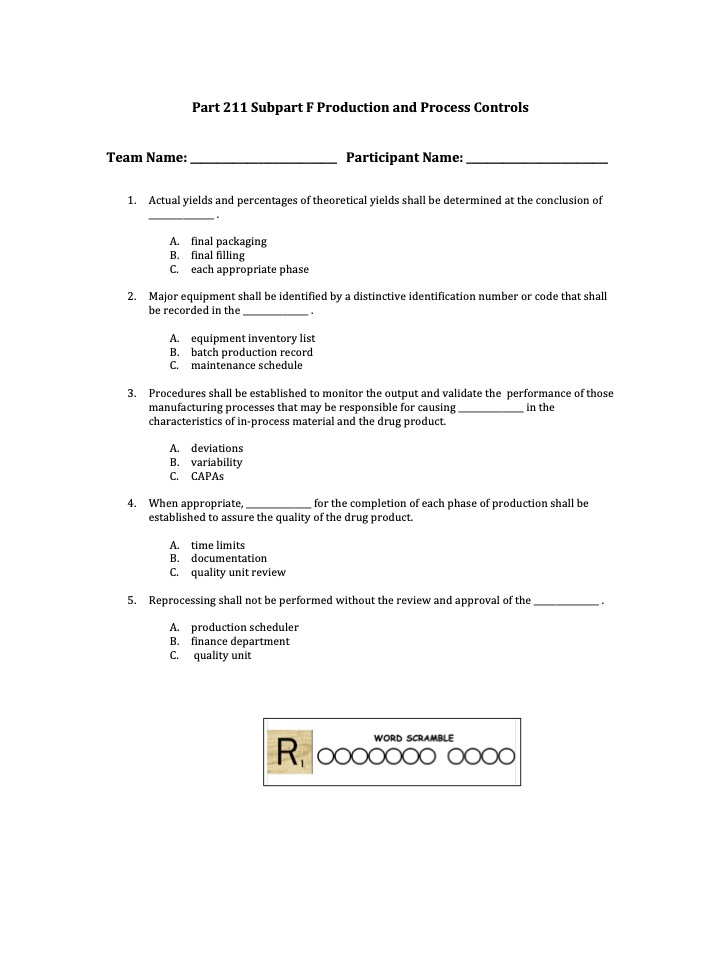
Weekly CGMP Quiz 6: Part 211 Subpart F Production and Process Control. Use with Your Team for Training Credit!

This is the sixth of eleven quizzes on CGMPs that will appear about weekly here at QA Pharm. Try it yourself and use as a discussion tool for your staff groups.

Also, each quiz will have one letter tile at the bottom. Collect all eleven tiles and unscramble the letters for an important message.

When you have completed all eleven quizzes, you will have satisfied the requirement in 21CFR211.25(a) for continuing CGMP training. Be sure to document this training according to your established procedures.

An answer key will be provided after the eleventh quiz to use for further discussion.

Click on image below:


Saturday, August 19, 2017

A Poster: Three Stages of Quality Management System Implementation and Oversight

A Poster: Three Stages of Quality Management System Implementation and Oversight

If I could summarize in one page the most important lessons I have learned in pharmaceutical Quality Assurance over the last 40 years, this is it.

This acknowledges that putting words in a procedure does not mean they will be put into action or be effective.

The responsibility of Quality Assurance is to ensure that an effective Quality Management System (QMS) is put in place procedurally, is in use behaviorally, and is in control measurably.

The responsibility of Management is to enable each element of the QMS by means of an identified owner; to provide oversight through performance metrics; and to promote the QMS as a normal and valued part of the business---not to make the FDA happy or pass an inspection.

As I reflect on my pharmaceutical career and the many clients I have served over the years, the best results and most rewarding experiences were with those who embraced this concept.

My hope is for all my followers to use this simple graphic as a way to communicate a QMS implementation strategy.

I would be pleased to support your effort with details behind each of these points.

If you would like a high resolution image, please write to me at my personal email address: snyderjohn@mac.com. You have my permission  to use freely.


The QA Pharm

Thursday, November 20, 2014

10 Points to Consider Before Becoming a Pharma Consultant

I am often asked for my advice on entering the consulting field, and I am happy to share my opinion from my own personal experience and what I have observed.

So here are 10 points to consider:

1. Family support is essential. You will be away from home most weeks. If you are someone with a young family; someone who likes to make all the decisions at home; someone who has a partner that has difficulty having you away from home---don't go into consulting.

2. Be financially stable. The consulting world is becoming more competitive and hourly rates are declining in many specialty areas. If the next on-time paycheck is critical for survival; if you cannot be without an income for six months--don't go into consulting.

3. Form your business entity. Don't mix personal and business money. Protect yourself by forming some type of a corporation. Talk to a accounting advisor who can listen to your unique situation to determine the best option for you. I am a "C Corporation," but make your decision on your needs, not what other consultants do.

4. Be realistic with your skills. Determine what your product is and refine it into tools, methods, approach, etc. Clients will readily detect when you have overstated you expertise. While it is acceptable to hone your skills and accrue more experience when consulting, it is not acceptable learn the subject on the clients' dime.

5. Charge by the hour. Consulting is typically billed by the hour, not the job. You have more control. Some clients may never agree when you are done.

6. Show something for your work. Agree upon deliverables with the client. What does "done" look like? Develop a common understanding of the client support required for the project to succeed. Know when you add value or not. When you no longer are adding value and just billing hours, discuss with the client. Warm-body-consultants give consultants a bad name.

7. Market through people who know you. Most projects come from people who know you directly and personally. Hopefully you have been building a network throughout your career from places you have worked and professional conferences. Being out in the consulting world is not a time to start thinking a network.

8. Be a consultant, not an employee. Study the IRS test rules for determining the difference between and employee and an independent consultant/ contractor. Don't allow either yourself or the client to cross the line emotionally or legally. If you feel you are "going to work" like you have all your life, you are not consulting.

9. Keep careful records. Not all clients require time and expense records. You should require it for yourself. Keep every cotton-picking receipts and a meticulous record of your hours: what you do and time. Never, ever pad the expense report or bill unreasonable hours.

10. Build-up, not tear down. You are there to help, not criticize. Avoid coming across as a "know-it-all". Lead the client to the point where they internalize and embrace your teaching. Find those among your client personnel who have that unexplainable spark, mentor them, and leave a legacy.


The QA Pharm


Thursday, October 23, 2014

Part 2: Responding to FDA483 Observations and Fulfilling Commitments

Part 2: Organizing to Get the Work Done

Responding to FDA483 observations was my focus in Part 1 of this series. Responses lead to commitments, and commitments lead to changes that are intended to prevent recurrence of the underlying problem that led to the observation.

In Part 2, I share my views on getting the work done to fulfill the FDA commitments. The following have become benchmarks from those who are the best at getting the job done in a sustainable way and getting the problems behind them:
  • Form teams. This might seem obvious, but forming cross functional teams representing stakeholders is often overlooked. The solution will very likely involve creating different ways of working that cross functional lines. It is a rookie mistake to think that the fix is something for the Quality Department to do on its own, or just an editorial change to a procedure. Depending on the problem, the team may need to be dedicated to allow focus, particularly if accelerated timelines are involved. Include subject-matter-experts that have the scientific, technical, and cGMP backgrounds to provide appropriate guidance.
  • Use consultants judiciously. Consultants can provide valuable additional support. They should bring relevant industry experience that can help scope the project and give practical advice that keeps the project moving toward the solution. The best consultants are good listeners who can help you design the right solution that works for you. But, if the only team members that show up to meetings are the consultants, something is terribly wrong. Do not outsource your responsibility to consultants. Let them help you, but it's your company and you own the results.
  • Determine the deliverables. Many teams go off the rails because they fail to determine the tangible deliverables that address the problem. You cannot grasps the degree of effort, determine the resource needs, or estimate the timeline until there is a clear vision of what "done" looks like. If you cannot describe "done," then you do not know the problem well enough.
  •  Solve the problem, not just the Commitment. Make a careful assessment of what it will take to prevent recurrence of the observation, not just satisfy the specific commitment. The FDA always states in the FDA483 that the observations are just examples and are not all-inclusive. Companies are expected to determine all that is necessary to permanently resolve the problem that underlies the observation wherever it applies. Perform a root cause analysis and ensure that the solutions are operational and sustainable. That invariably involves more work that the narrow view of a specific example cited in an observation or the response given.
  • Determine how you will know the problem is solved. In true fashion of a CAPA, determine how you will measure effectiveness. What will tell you that the solution worked? What will be your first sign that it did not work? Consider whether this is yet another attempt at solving the same old problem. Remember that recurring observations lead to increased levels of enforcement. Be sure you know the problem is truly solved.
  • Avoid Information Technology (IT) Solutions. This may sound a bit strange, but in my personal experience, nearly every commitment made in a FDA483 response that involved an IT solution missed the commitment date by light-years. I know that it should not have to be that way. I'm just saying that in my 20 years of consulting experience, that has always been the case. Consider applying an IT solution as a later improvement, not within the commitment time line if at all possible.
  • Use Project Management Principles and Tools. Quality System development work is not like a capital project where much of what is needed to estimate the time and cost is known upfront. Quality system and compliance projects are more often like exploratory surgery where a lot is learned once you open it up the patient. You may discover that multiple linking systems are affected after you start looking at the problem more deeply.  Recognize that plans will need to be adjusted along the way. Do not confuse progressive revelation with scope creep. Be adaptable. Establish plans and reports based on the work and target dates, not subjective feel-good dashboards with perpetual dates that slip. Anticipate problems with hitting the date and mitigate them before failure is a foregone conclusion. When you see that the timeline is slipping, ask for help and consider first what it will take to get back on track. Don't just keep moving the target date back as the default solution.
  • Provide Infrastructure Support. Remediating compliance problems often require new ways of thinking, not just new ways of working. Compliance problems frequently go hand-in-hand with company culture problems. Progressive companies that recognize the business value of an effective Quality Management System also recognize the opportunity that regulatory inspections provide to examine its culture and values. Change management coaches can help a company adapt to the changes required to support a quality and regulatory compliance culture. Recurring compliance problems are frequently a culture problem that discounts the value of an effective Quality Management System and regulatory compliance to the business. 
  • Provide Management Support. Ensure that each project team has a sponsor who is the best fit based on the functional owner of the process being remediated. Clearly identify the role of the sponsor and ensure that it includes removing obstacles such as lack of organization alignment, stalled decisions, team dysfunction, and inadequate budget. Sponsors are the champions who are willing to delve into the level of the working team to provide visible support, rather than sit on the management team and undermine their own folks at project update meetings. Being sponsors of quality system remediation projects provides a unique opportunity for function heads to understand dependent processes across functional lines.
  • Establish Governance Oversight. The work associated with fulfilling commitments is tightly connected to managing risk. Thus, it is important to keep site governance councils frequently updated with progress and informed about unacceptable risks. These risks always include the risk of meeting a commitment date made to the FDA. Take commitment dates seriously. Other unacceptable conditions uncovered along the way should also be communicated to the governance body. Establish clear lines of communication and escalation between the team that actually does the work and governance. Learn how to escalate and resolve potential problems quickly. Nothing consumes the timeline as much as reluctant escalation and indecision.
  • Verify that Deliverables Solve the Problem. Take an independent look to ensure the work is completed and that the tangible deliverables are in-place and in-use. This is a good role for an independent consultant. It is far better to find out for yourself that the mark was missed than for the FDA to call it to your attention as a repeated observation. Be a healthy skeptic and ask, "How do we know for sure the problem is permanently solved?"
  • Revisit Commitments. Although you may have verified that the solution is in-place and in-use, revisit the problem at an appropriate time interval to ensure that the organization has not reverted to the old ways of working.
How have you managed regulatory commitments? What are your success stories? What have been epic failures, and why?


The QA Pharm

Friday, October 17, 2014

Part 1: Responding to FDA483 Observations and Fulfilling Commitments

Part 1: The FDA483 Response

In this two-part series will discuss responding to the FDA483 and getting the work done to fulfill the commitments in a sustainable way.

Unlike a Warning Letter, a response is not required--but highly advisable. It is standard industry practice to respond to FDA483 observations. Responsible companies that want to have a good relationship with the FDA respond to each observation by saying exactly how problems will be addressed.

There is plenty advice available, even from the FDA, on what constitutes a good response. For certain, the difference between a good and a poor response may differentiate how you are viewed by the FDA.

From my experience, the following are points to consider that have worked well when forming a response:
  • Do you agree with the response? Stating up front that you either agree or disagree, in part or on the whole, stages the rest of the response. Think twice before you say you completely disagree especially with everything-- because the FDA will always have the regulations, industry good practice, and the facts on their side. But it is quite possible that the FDA investigator got the facts wrong or drew the wrong conclusion. This is why a close-out meeting with investigators at the conclusion of the inspection is important. It is better to straighten out the record at the close-out meeting than in the FDA483 response.
  • Defend what you are doing right. The examples of violations cited in observation are just a snapshot in time. Although you may not be proud of what was found, the finding may not be representative of the current state of control. The example may pre-date significant improvements that you have made on your own initiative, although they may be in progress and not fully implemented. Be sure to give yourself credit for such improvements. The last thing you want to do is give the impression that the FDA was the first to call a problem to your attention.
  • Take product lot numbers seriously. When the FDA mentions specific lot numbers associated with a problem, it immediately puts you in the position of having to defend why those lots are still on the market, and why you have not shut down manufacturing associated with that product, process, or facility. Put your best minds and writers to work to lay out the defense of your release decision and the state of control. Be objective and use data. If you come to the conclusion, albeit late in the game, that the product should be recalled, seriously consider the right thing to do. Also take into account causing a critical drug shortage, because the FDA will work with you to avoid a shortage while you resolve inspection-related problems.
  • Defend State of Control. Some types of observations paint a picture of being out of control, particularly when it is associated with validation, sterility assurance, potency, content uniformity--you know--the SISPQ issues. Also, taken collectively, observations that run the gamut of the quality system can indicate a precarious state of control. Take your best, realistic, honest shot at how you know you are manufacturing and distributing a safe, quality product. And, for goodness sake, do not--I repeat--do not anchor your defense that there have been no complaints or dead bodies in the street. Meeting all end product specifications may be the best defense you have if statistically treated, but be aware that a "final product spec" defense will always peg you as a 1970s time traveler.
  • Commit to Action. Address the specific issues that were called to your attention, but do not stop there. Carefully determine the root causes of the issues cited in the observations. There will not always be a one-to-one relationship of root cause to observation. Nonetheless, run the problem to ground and understand what is behind the problem. Determine the action required to prevent the reoccurrence of the problem cited. Undoubtedly, the solution will require changes in multiple areas at the system level. Be sure to convey that you are taking system-level action, not just addressing the superficial, specific examples. Remember, observations are just examples. Indicate the action you promise to take and target completion date. Be clear in advance what "done" looks like and the specific deliverables that will provide the evidence of successful completion.
  • Commit to Developing Appropriate Action. If you do not know exactly what all is necessary to fix the problem, it is completely acceptable to indicate that the scope of activities and target dates will be established in a plan to be provided later. But state in the response when the plan will be completed and provided. Major milestones and target month are usually acceptable in a follow-up communication.
  • Recognize the Minimalism. Very likely you have taken a minimum essential approach to the commitment. By the time all the internal reviewers have edited the response, you have pared down the work to something manageable for normal business. However, the work associated with FDA inspection observations is not normal business. The scope of the actual work required to prevent recurrence of the observation may be more than expected when you actually delve into the root cause and prevent recurrence through systemic changes. 
  • Provide Realistic Target Dates. There is always a balance between showing responsiveness with aggressive target dates and over committing to unrealistic dates. When dealing with operational and quality system problems, there may be more work involved than meets the eye. Some problems may require engineering studies or process development in order to understand the right approach to take when solving a problem. Take time to really think through all that is involved in order to provide realistic target dates. You don't want to go back to the FDA--at least not too often--to revise target dates. Do inform the FDA of changes in completion dates. Don't let a broken promise be a surprise when they return to reinspect. It's far better to inform them in advance.
  • Engage Your Internal Associates. I cannot tell you how often I discover the situation where commitments and target dates were given to the FDA in very well written responses, but those who carry out the work were not involved--even totally clueless. It's best to involve those who have to fulfill the commitments in the actual writing of the response. Time is of the essence when preparing a response, but cutting out those who actually do the work will always uncover significant execution issues at the worse possible time.
  • Take FDA Suggestions. When the FDA makes a suggestion about retaining a GMP consultant to assess your overall quality system and help you to improve--take the suggestion. This recommendation usually comes in Warning Letters where the FDA has come to the conclusion from the breadth of problems and recurring problems that there is no confidence in your Quality Unit or Management Oversight. Consider such a recommendation as a direct hit and taking on water, not just a shot across the bow. So be responsive and act accordingly.
What is your experience with preparing regulatory observation responses? What has worked well? What has not worked well?

In Part 2 I will talk about organizing to get the work done to fulfill commitments.


The QA Pharm


Tuesday, September 16, 2014

If You Need a Burning Platform to Justify Change, You Must Like Firefighting

Often times pharma has a split personality. One personality loathes firefighting, and the other personality needs a burning platform to justify doing anything that requires spending money.

Go figure.

This becomes evident in our industry when some companies cannot part with a pittance of their multi-billion dollar profit to establish or ensure that an effective and sustainable Quality Management System (QMS) is in place--along with suitable facilities for intended use and sufficient staff levels.

This is really obvious when such companies are at the heart of the devastating drug shortage problem. The burning platform appears in the form of regulatory enforcement action, disgorgement and penalty fines, consumer stakeholder lawsuits, loss of goodwill from patient advocate groups, and a drop in stock price.

A burning platform you want? A burning platform you get.

But what about the patient? 

The patient deserves better. No company can claim to put the patient first without solidly and confidently knowing that an effective QMS is in place, in use, and providing the data-driven evidence that you are operating in a state of control. 

But that is way too boring. 

It is much more exciting to emerge victorious from the daily firefights. The person who rescues the baby will always get more recognition than the schmuck who goes around changing the batteries twice a year in the smoke detectors.

So the next time you hear someone say that there is no burning platform to motivate spending the money, investing the capital, or authorizing the project, tell them it is too late when the platform is on fire. Make the business case that the QMS and other worthwhile quality / compliance projects are an investment in ensuring a reliable supply of quality products to desperately needy patients. 

You will always spend more money at the most inconvenient time and under the most impossible timelines when you have to react to a crisis. Smart companies know how to anticipate a problem; not react when the damage is done.

Waiting for the platform to burn ends up scorching the patient.


The QA Pharm


Sunday, August 3, 2014

The Quality Management Triad: a Model for Performance Sustainability

Establishing a sustainable Quality Management System that helps a company to become an anticipating, rather than a reactive organization requires intentional effort to bring three essential element together. I call these elements the Quality Management Triad.


The first part is Quality Governance, this is the body that provides:

    • Vision—the aspirational view of the future, and how Quality Management is integral to the business strategy for operational performance and continuous product availability to patients;

    • Leadership—the top business unit and functional heads who motivate, align, plan, and engage the organization toward its quality goals;

    • Standards—endorse the policies and norms, which establish the quality requirements—the interpretation of laws and regulations to your operation—the “what” is required;

    • Oversight—the communication channels and forums that give Leadership visibility to product quality and compliance risks and trends—in order to make effective data-driven decisions—and provide Leadership the means to exercise management responsibility.

The second part is the Pharmaceutical Quality System (which is the ICH Q10 term for the Quality Management System). The Pharmaceutical Quality System—or PQS:

    •  Management System—the totality of policies, standards, processes that directs and controls activities with regard to quality;

    • Processes—to ensure consistency and intentional ways of working when applying the standards to your operation—and to control variables, including the human variable;    

    • State of Control—quality is about controlling variation, and the Pharmaceutical Quality System provide the capability of self-detecting and self-correcting problems and give us a clear picture of our current state of control.

    • Continuous Improvementknowing the top regulatory compliance risks at any give time and having project teams directed toward resolving them with verifiably effective solutions.


The third part is Quality System Ownership, which is the specific application of the concept of Business Process Ownership that sets expectations and accountability for managing the constituent parts of the Pharmaceutical Quality System:  Ownership responsibility includes:

    • Execution—they manage the daily operation of the quality processes described in procedures and ensure procedures are effective;

    • Maintenance—they ensure that the quality process remains current with regulatory requirements and industry practices; and remain applicable to your changing business;

    • Performance—they measure how well the process is working and identify problems with the process, and problems that the process detects—and always seeking ways to meet the requirements in the most efficient way.

    • Escalation—they identify unacceptable conditions or events that puts the patient and the business at risk—and take the immediate actions necessary to mitigate the risk, and make recommendations for permanently solving the problem.

At the center is the Quality function whose responsibility it is to engineer the processes for these three parts, and to ensure that they work—and work together effectively.
To be clear—quality is everyone’s responsibility. Much like Safety is everyone’s responsibility, it is the Quality function’s responsibility to establish the ways and means for the Quality Management Triad; and ensure effectiveness.

Why is The Quality Management Triad important?

The pharmaceutical industry is a dynamic business environment.  Acquisitions, operational realignment, portfolio changes, manufacturing relocation, facility re-purposing, and organization restructuring and integration are among the strategies to increase stockholder value. These continual changes impact the Quality Management System, and like any other aspect of the operation, it must be managed to remain effective and relevant.

Take this hypothetical example: 

A single-ingredient, solid-oral tablet manufacturer that constructed a dedicated facility for their new product.

Later, high-potency, multi-ingredient tablets were introduced into this facility as line extensions. The facility was then expanded to manufacture oral liquids and eventually retrofitted to produce oral suspension products.

Plans were being made to introduce parenteral drugs into the facility when the decision was made to enter into an agreement with a contract manufacturing operation—a CMO—for that technology, which was the firm’s first venture into a third-party partnership.

All the while, volumes were increasing, markets became global and the company turned to a twenty-four seven operation to keep up with demand. The increased profitability was directed toward the development of promising new drugs, while operating expenses were reduced and tightly controlled to fund new initiatives.

While this was great news for investors and employees, an unintended consequence was quietly undermining the business. The Pharmaceutical Management System had not evolved with the business, and was no longer capable of reliably detecting and managing product quality and compliance risks.

“Loss of management control” was the underlying theme of the series of FDA483s and the eventual warning letter when the site was fraught with recurring manufacturing deviations, missed target dates, and ineffective solutions promised to the Agency.

Although this is a hypothetical case, many people identify with some parts of this story when I share it.

Unfortunately, the Quality Management System is often viewed as a resilient tome of instructional content with little susceptibility to changes in the business environment. Nothing could be farther from reality.

Quality professionals across the industry who have looked back at their past quality problems and regulatory enforcement action, say—ironically—that their Quality Management System was a victim of their success.

Whatever the environment, the Quality Management System must be managed to ensure that it is Fit-for-Purpose and that it continually serves and protects the business.

The Quality Management Triad is a key element of a business strategy to sustain performance and ensure a continuous supply of quality product to patients.


The QA Pharm

Wednesday, September 4, 2013

Ownership Responsibility for the Pharmaceutical Quality Management System: Setting New Expectations

In Texas we have an expression: If it's left to two people to water the horse, the horse will go thirsty.

Our quarter horses are well-watered because of established roles and responsibilities around the ranch. But I am no longer surprised that in the pharma industry it's not that easy to point to who is responsible for what when it comes to the details of the quality management system.

I typically get one of two responses to the question, "Who owns the [fill in the blank] system?" Whether it is Training and Qualification, Deviation and CAPA, Document Management, Complaint Handling--or whatever-- it's the same:
  • Ultimately it is the Head of Quality, or
  • What do you mean "own" (or responsible) exactly?
Sure, the Head of Quality has the ultimate functional responsibility, and in the sense of the Park Doctrine, the CEO has the penultimate responsibility. But that is a neither practical or effective.

I published an article that discusses the importance of identifying clear ownership at the operational level for each element of the quality management system and the benefits to the business when new expectations are set.

Follow this link to read the article on IVT Network-->  Ownership Responsibility

I hope you find this article beneficial. Write to me, or post a comment to this blog and tell me what you think.


The QA Pharm


Friday, August 23, 2013

"Murder for Diversion" The first Jacob Blake Pharma Mystery by John Snyder

I started the QAPharm Blog three years ago as a creative outlet to share my perspective on the pharma industry and the quality assurance profession. I have appreciated my faithful readers from dozens of countries around the world.

As many of my readers have noted, I took a hiatus from blogging for a year. During that time I wrote the first "whodunit" murder mystery ever set the the pharmaceutical industry.

Murder for Diversion by John Snyder is the first Jacob Blake murder murder mystery, and it is available at Amazon for your Kindle. I hope you enjoy it.

Just like my blog, it is infused with my experience in the pharmaceutical industry, but it is a true work of fiction. All places, events and characters are the product of my imagination. 

Here's a little bit about my book and protagonist Jacob Blake.


Jacob Blake is reinventing himself.  He's an expert in pharmaceutical manufacturing quality, but his career and his life is at a crossroads, when an uncle dies and leaves him property in, of all places, Texas. He drives cross-country, thinking that maybe this is a sign, a direction for him to go.  But his old life calls, and his ex-boss and nemesis in Philadelphia asks him to take a look at a mystery.  His first inclination is to not look back, then his old boss is suddenly dead, leading Jacob into a world of shady dealings, and murder.  This is the first in a planned series looking at what the public doesn't know about how the drugs they take every day are made and following a character in his journey of re-creation and life renewal. 


So, if the book was written by John Snyder and I am QA Pharm, then QA Pharm must be John Snyder.


I hope you enjoy the book and continue to check in with me here at The QA Pharm. 

I am very happy to know you.


John Snyder
The QA Pharm