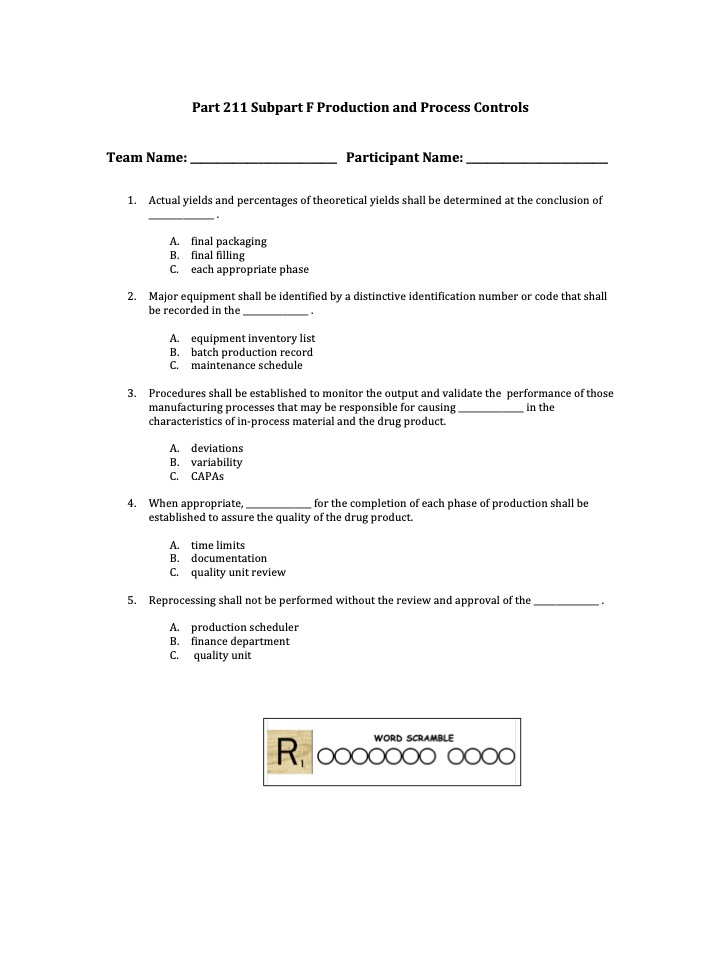
This is the tenth of eleven quizzes on CGMPs that will appear about weekly here at QA Pharm. Try it yourself and use as a discussion tool for your staff groups.
Also, each quiz will have one letter tile at the bottom. Collect all eleven tiles and unscramble the letters for an important message.
When you have completed all eleven quizzes, you will have satisfied the requirement in 21CFR211.25(a) for continuing CGMP training. Be sure to document this training according to your established procedures.
An answer key will be provided after the eleventh quiz to use for further discussion.
Click on image below:
This blog is straight talk about quality assurance in the pharmaceutical industry. Not the technical aspects as much as the challenges faced by company management and their internal quality assurance professionals—sometimes side-by-side and often toe-to-toe.
Showing posts with label training. Show all posts
Sunday, December 29, 2019
Sunday, December 15, 2019
Weekly CGMP Quiz 8: Part 211 Subpart H Holding and Distribution. Use with Your Team for Training Credit!
This is the eighth of eleven quizzes on CGMPs that will appear about weekly here at QA Pharm. Try it yourself and use as a discussion tool for your staff groups.
Also, each quiz will have one letter tile at the bottom. Collect all eleven tiles and unscramble the letters for an important message.
When you have completed all eleven quizzes, you will have satisfied the requirement in 21CFR211.25(a) for continuing CGMP training. Be sure to document this training according to your established procedures.
An answer key will be provided after the eleventh quiz to use for further discussion.
Click on image below:
Also, each quiz will have one letter tile at the bottom. Collect all eleven tiles and unscramble the letters for an important message.
When you have completed all eleven quizzes, you will have satisfied the requirement in 21CFR211.25(a) for continuing CGMP training. Be sure to document this training according to your established procedures.
An answer key will be provided after the eleventh quiz to use for further discussion.
Click on image below:
Sunday, December 8, 2019
Weekly CGMP Quiz 7: Part 211 Subpart G Packaging and Labeling Control. Use with Your Team for Training Credit!
This is the seventh of eleven quizzes on CGMPs that will appear about weekly here at QA Pharm. Try it yourself and use as a discussion tool for your staff groups.
Also, each quiz will have one letter tile at the bottom. Collect all eleven tiles and unscramble the letters for an important message.
When you have completed all eleven quizzes, you will have satisfied the requirement in 21CFR211.25(a) for continuing CGMP training. Be sure to document this training according to your established procedures.
An answer key will be provided after the eleventh quiz to use for further discussion.
Click on image below:
Also, each quiz will have one letter tile at the bottom. Collect all eleven tiles and unscramble the letters for an important message.
When you have completed all eleven quizzes, you will have satisfied the requirement in 21CFR211.25(a) for continuing CGMP training. Be sure to document this training according to your established procedures.
An answer key will be provided after the eleventh quiz to use for further discussion.
Click on image below:
Sunday, December 1, 2019
Weekly CGMP Quiz 6: Part 211 Subpart F Production and Process Control. Use with Your Team for Training Credit!
This is the sixth of eleven quizzes on CGMPs that will appear about weekly here at QA Pharm. Try it yourself and use as a discussion tool for your staff groups.
Also, each quiz will have one letter tile at the bottom. Collect all eleven tiles and unscramble the letters for an important message.
When you have completed all eleven quizzes, you will have satisfied the requirement in 21CFR211.25(a) for continuing CGMP training. Be sure to document this training according to your established procedures.
An answer key will be provided after the eleventh quiz to use for further discussion.
Click on image below:
Also, each quiz will have one letter tile at the bottom. Collect all eleven tiles and unscramble the letters for an important message.
When you have completed all eleven quizzes, you will have satisfied the requirement in 21CFR211.25(a) for continuing CGMP training. Be sure to document this training according to your established procedures.
An answer key will be provided after the eleventh quiz to use for further discussion.
Click on image below:
Sunday, November 17, 2019
Weekly CGMP Quiz 4: Part 211 Subpart D Equipment. Use with Your Team for Training Credit!
This is the fourth of eleven quizzes on CGMPs that will appear about weekly here at QA Pharm. Try it yourself and use as a discussion tool for your staff groups.
Also, each quiz will have one letter tile at the bottom. Collect all eleven tiles and unscramble the letters for an important message.
When you have completed all eleven quizzes, you will have satisfied the requirement in 21CFR211.25(a) for continuing CGMP training. Be sure to document this training according to your established procedures.
An answer key will be provided after the eleventh quiz to use for further discussion.
Click on image below:
Also, each quiz will have one letter tile at the bottom. Collect all eleven tiles and unscramble the letters for an important message.
When you have completed all eleven quizzes, you will have satisfied the requirement in 21CFR211.25(a) for continuing CGMP training. Be sure to document this training according to your established procedures.
An answer key will be provided after the eleventh quiz to use for further discussion.
Click on image below:
Sunday, November 10, 2019
Weekly CGMP Quiz 3: Part 211 Subpart C Buildings and Facilities. Use with Your Team for Training Credit!
This is the third of eleven quizzes on CGMPs that will appear about weekly here at QA Pharm. Try it yourself and use as a discussion tool for your staff groups.
Also, each quiz will have one letter tile at the bottom. Collect all eleven tiles and unscramble the letters for an important message.
When you have completed all eleven quizzes, you will have satisfied the requirement in 21CFR211.25(a) for continuing CGMP training. Be sure to document this training according to your established procedures.
An answer key will be provided after the eleventh quiz to use for further discussion.
Click on image below:
Also, each quiz will have one letter tile at the bottom. Collect all eleven tiles and unscramble the letters for an important message.
When you have completed all eleven quizzes, you will have satisfied the requirement in 21CFR211.25(a) for continuing CGMP training. Be sure to document this training according to your established procedures.
An answer key will be provided after the eleventh quiz to use for further discussion.
Click on image below:
Sunday, November 3, 2019
Weekly CGMP Quiz 2: Part 211 Subpart B Organization and Personnel. Use with Your Team for Training Credit!
This is the second of eleven quizzes on CGMPs that will appear about weekly here at QA Pharm. Try it yourself and use as a discussion tool for your staff groups.
Also, each quiz will have one letter tile at the bottom. Collect all eleven tiles and unscramble the letters for an important message.
When you have completed all eleven quizzes, you will have satisfied the requirement in 21CFR211.25(a) for continuing CGMP training. Be sure to document this training according to your established procedures.
An answer key will be provided after the eleventh quiz to use for further discussion.
Click on image below:
Also, each quiz will have one letter tile at the bottom. Collect all eleven tiles and unscramble the letters for an important message.
When you have completed all eleven quizzes, you will have satisfied the requirement in 21CFR211.25(a) for continuing CGMP training. Be sure to document this training according to your established procedures.
An answer key will be provided after the eleventh quiz to use for further discussion.
Click on image below:
Saturday, October 15, 2011
Top Ten Ways to Make GMP Training Relevant
Most GMP training that I encounter is not necessarily bad--just irrelevant. In fact the same could be said for the Training Department. They jealously guard their turf and deliver mediocre, perfunctory training. Names get checked off the list, and the Training Department goes about their business being irrelevant. (Ouch!)
There is nothing that could be more exciting and fulfilling than being part of a dynamic training group that equips its organization to be a finely tuned work force of scholars that embrace GMPs as a business enabler.
Unfortunately, rather than a graduate education in the pharmaceutics of regulations, our best and brightest are subjected to a mind-dulling deck of tired old PowerPoint slides.
Frankly, the problem is endemic and here's why:
There is nothing that could be more exciting and fulfilling than being part of a dynamic training group that equips its organization to be a finely tuned work force of scholars that embrace GMPs as a business enabler.
Unfortunately, rather than a graduate education in the pharmaceutics of regulations, our best and brightest are subjected to a mind-dulling deck of tired old PowerPoint slides.
Frankly, the problem is endemic and here's why:
1. The concepts are not applied to the real world. We herd the mignons into the cafeteria and deliver the obligatory annual GMP training with total disrespect for what each employee does as part of his/her job everyday.
2. Training topics are not strategic. The lack of the broader view of the state of the industry and regulatory enforcement trends keeps GMP training from being proactive or responsive to the changing regulatory environment.
3. Training is not data-driven. The topics selected are often disconnected from the problems at the site as revealed at quality metric review forums such as Quality Management Review.
4. Training is the ubiquitous excuse (punishment) for corrective and preventive action. The easy out is to say that a failure can be addressed by training without truly determining the root cause.
5. The training method is not effective. When everything from a step change to a total system re-design is handled by "Read and Understand," it is difficult to distinguish between minor and really significant training topics.
6. The trainers are dreadfully boring. It's amazing how much we devalue the importance of training as evidenced by the little emphasis we place on the design and delivery skills we place on the people we put in those positions.
7. Lack of attendance is tolerated. When there is a conflict in one's schedule, the training class is always the loser. Nothing ever happens if you don't attend, because usually know one knows. No one really cares.
8. Leaders don't go to training either. It's comes down to not really expecting leadership to be trained, as though there is some special dispensation with the privileged class. They certainly aren't examples to follow.
9. The priority of the production manager is getting product out the door, not the skills and capability of his/her workers. In fact, he/she may be totally unaware of whether the workforce is getting the right training, or current with meeting individual training requirements.
10. Measurable improvement in skills and knowledge is not rewarded. We reward what we value, and training isn't it.
So, class, here's your assignment:
Turn each of these negative statements into a positive one. Then perform a self assessment of your organization against these statements.
Don't be defeated if the results are pathetic. You are in good company. It's all about what you do with the information starting right now.
Turn these into vision statements. Discuss the practical, measurable steps you can take to improve the relevance of your GMP training.
Keep it going, and watch amazing things happen!
The QA Pharm
10. Measurable improvement in skills and knowledge is not rewarded. We reward what we value, and training isn't it.
So, class, here's your assignment:
Turn each of these negative statements into a positive one. Then perform a self assessment of your organization against these statements.
Don't be defeated if the results are pathetic. You are in good company. It's all about what you do with the information starting right now.
Turn these into vision statements. Discuss the practical, measurable steps you can take to improve the relevance of your GMP training.
Keep it going, and watch amazing things happen!
The QA Pharm
Saturday, July 17, 2010
An Intriguing Executive GMP Tutorial
I was invited by a disheartened head of a pharmaceutical QA department to provide a private tutoring session for the company COO on the topic of Current Good Manufacturing Practices. She said that he had refused to participate in the half-day annual GMP training course.
This was a rather intriguing request.
I asked a few questions of her to be sure that I understood the need to be addressed, the objective of the private session, and any other parameters to be considered.
Her answers were just as intriguing.
The perceived need: The boss “just doesn’t get it.”
The objective: To gain his support for GMP-related decisions.
There was only one working parameter: I had thirty minutes.
I still took the assignment, well—because it was intriguing.
I sat down and wrote out a simple discussion outline of the underlying principles of GMPs and made sure that it was straight-talk and free of buzzwords. Instead of “presenting” to him, we said that the thirty minutes would just be a “conversation.”
After belabored calendar coordination, this is the outline of the conversation that took place:
1. Patients take the individual dose, not the average—sometimes everyday for their entire life.
a. Your patients deserve the assurance that their drug will meet every quality requirement for each dose, not just on the average.
b. That’s the objective of GMPs, and that should be no less the objective of your business.
2. Your manufacturing process is fraught with opportunities for unwanted variation to creep in.
a. All the way from incoming raw materials and components, to your equipment, test methods, operators, facilities, utilities, and so forth.
b. Continually producing a product that is faithful to what your market approval was based on and all your quality requirements only happens when you do so intentionally.
3. Your standard operating procedures declare how you intend to control variation.
a. The operative word is “standardize,” not “randomize” the way you work.
b. You have the liberty to standardize how you control variation and meet regulatory requirements to be as efficient as possible.
4. When you follow your standard operating procedures, records are created that capture the results of your intent.
a. The way you record results and when you enter these results are important.
b. Sometimes recording of the result is so critical to the outcome that it must be witnessed.
5. These records contain data that measure how well you achieved your intent.
a. The data can be interpreted into information.
b. The information can be transformed into targeted action for improvements.
6. A regularly review of these measures by a cross-functional management group is your mechanism to provide oversight and governance.
a. The review enables you to be an anticipating organization, rather than a reactive one.
b. This review is your primary source of knowledge that you are operating in a state of control.
7. When you put this all together, you will be able to maintain economical control of quality and increase your ability to compete.
a. GMPs are an enabler of your business, not an antagonist.
b. GMPs enable continuous quality, which is quality you trust.
8. This pretty much summarizes the purpose of GMPs, which are embodied in your quality management system.
a. This is fundamentally no different than how you manage sales and marketing to ensure that each of your regions is performing to expectations. If not—you adjust.
b. The quality management system will be your best friend, and your best defense to regulatory inspectors—as well as personal injury attorneys.
The conversation was an absolutely engaging. The COO had never thought of GMPs in these terms.
He wanted to know how he could personally help to communicate the value of GMPs across the business.
The thirty minutes? As I left the room, the COO and the head of quality were still talking.
Sometimes one needs to reach out to the key players in the organization with a customized message, not drag them in to the same-old-same-old.
Mission accomplished. Intriguing.
The QA Pharm
Subscribe to:
Posts (Atom)